


Valpolicella Land: Zones, Valleys, and Terroir


Yes. Valpolicella is a single denomination, but it is not a single uniform place. The production area forms a broad piedmont strip in the province of Verona, with Lake Garda to the west and the Lessini Mountains providing protection to the east and north. The landscape is shaped by a series of valleys that open out from Verona, creating a mosaic of exposures and growing conditions that can influence ripeness, acidity, and structure.
If the great Nebbiolo wines of Piemonte are Italy’s Burgundy, then Valpolicella might be its Bordeaux. Its variety and variability, the abundance of microclimates, and the moderating influence of being between two water sources (in Valpolicella, Lake Garda and the Adige, with wider influences from the Adriatic) help explain why this denomination can produce an extreme range of wines, from honest everyday reds to the brooding seriousness of top of the range wines of considerable ageability and, let’s be honest, expense.
But while many famous regions are familiar to wine lovers worldwide, the valleys and villages of Valpolicella often remain, for many, just names on bottles. That is a shame, because knowing the geography can genuinely guide choices. This guide cannot cover everything, but it can serve as a clear reference to the region and its terroir, with practical implications for how the wines taste.
The Consorzio della Valpolicella describes the denomination as spanning 19 municipalities, with a historic core and a wider surrounding area. Within the production rules, Valpolicella is formally divided into three zones: Valpolicella Classica, Valpantena, and the broader Valpolicella DOC area. These terms are not marketing concepts. They refer to geography, and they often help explain why two Amarone wines can taste very different even when made from the same grapes and the same technique.


Where does the name Valpolicella come from?
There is much speculation and little certainty as to the origins of the name “Valpolicella”. The first known appearance is in a 12th century document as “Val Polesela”. Some interpret the name as “valley of many cellars” (often explained as a blend of Greek and Latin roots), while others see it as a reference to the fertility of the land.
The first known appearance of the name is in a 12th century document as “Val Polesela”.
It is worth noting that fertility can be a double edged sword: the most fertile plains are excellent for orchards but often too productive for quality wine grapes. A widely repeated rule in viticulture is that a vine produces its best fruit when it has to work, not when it is overly comfortable.
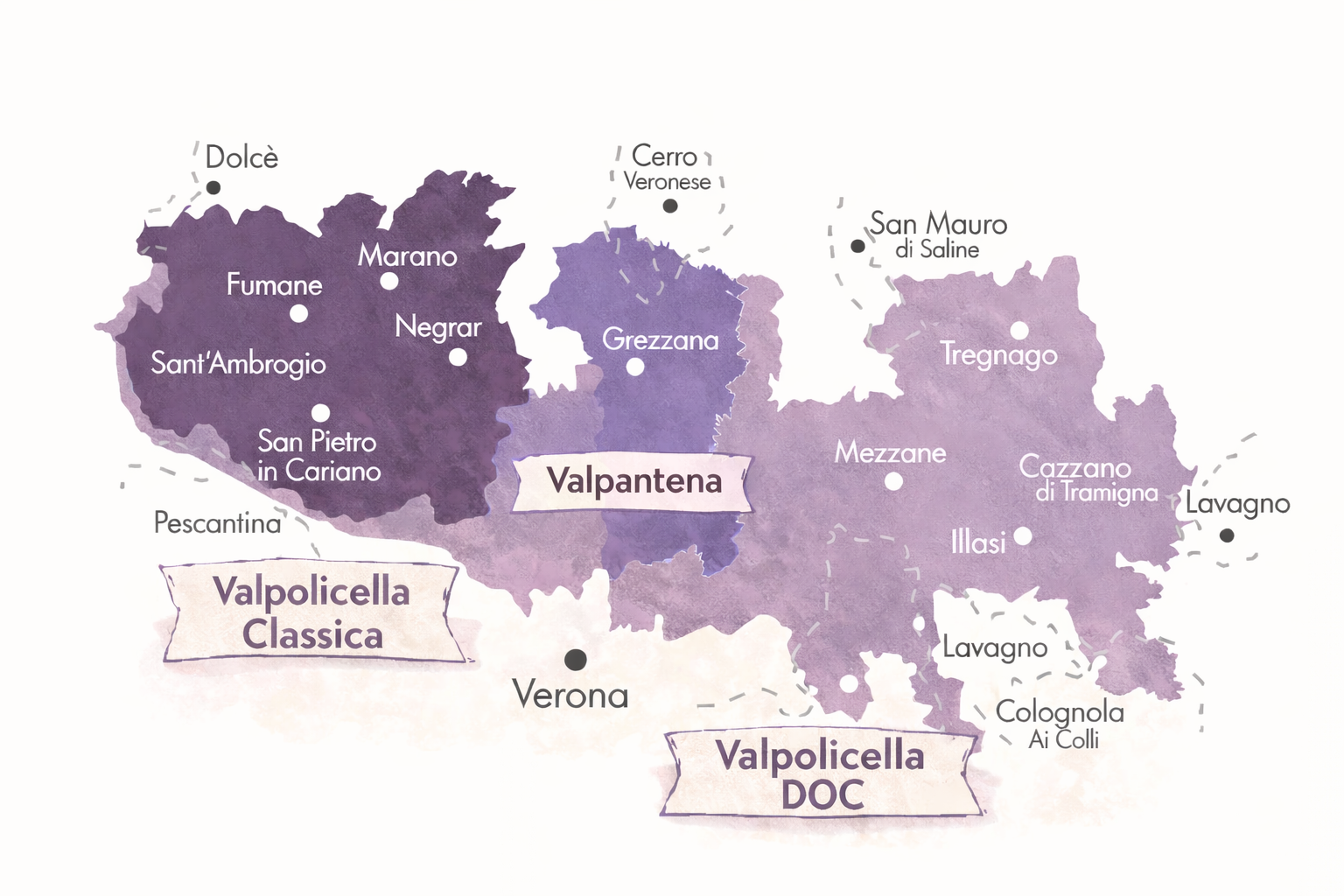
Where exactly is Valpolicella?
Valpolicella is an area of land in the northern part of the province of Verona. It is contained by the Lessini Mountains to the north, borders the province of Vicenza to the east, meets the city of Verona to the south, and faces Lake Garda and the Adige River to the west. Within these broad borders, the region is shaped by valleys, slopes, and plains, which is why it is better understood as a mosaic of places rather than one uniform landscape.
A poor soil can be desirable in viticulture: vines tend to produce better fruit when they struggle for water and nutrients. That is why the higher hills, with stonier and better draining soils, often matter so much in Valpolicella, especially for wines of depth and longevity.
Which municipalities make Valpolicella?
The denomination officially includes the following municipalities:
Historic Classica area
- Sant’Ambrogio di Valpolicella
- San Pietro in Cariano
- Fumane
- Marano di Valpolicella
- Negrar di Valpolicella
Valpantena
- The Valpantena valley within the municipality of Verona
Broader Valpolicella DOC area
- Dolcè
- Pescantina
- Verona
- San Martino Buon Albergo
- Lavagno
- Mezzane di Sotto
- Tregnago
- Illasi
- Colognola ai Colli
- Cazzano di Tramigna
- Grezzana
- Cerro Veronese
- Sant’Anna d’Alfaedo
- Selva di Progno
- Montecchia di Crosara
Seeing these names on a back label or technical sheet adds context. Even within the same zone, a hillside in Marano or a site in Illasi can behave very differently in terms of temperature, exposure, and soil.
How does the geography change the wine?
Across the region, vineyards sit at different elevations and landforms, from higher limestone areas linked to the Lessini Mountains, to hills where most vineyards are planted, to flatter valley floor sites. In practical terms, cooler and higher vineyards tend to preserve acidity and aromatic lift, while warmer and lower sites can encourage richer fruit and softer natural acidity.
Soil also varies widely. Limestone and calcareous formations are common, especially in higher areas, often supporting structure and tension. Clay based soils can give breadth and weight. In parts of the eastern valleys, volcanic components appear, contributing different texture and, in some cases, a firmer acidic line.
This is why it is often more accurate to think of Valpolicella as a set of interconnected valleys rather than a single taste profile. The internal differences are real and can be clearly tasted in Amarone.


Which other valleys make Valpolicella?
Valpolicella is often described through its three official zones, but the territory is also marked by a wider set of valleys. Traditionally, people speak of multiple valleys that define the region’s shape and microclimates. Alongside the best known names, you will also see references to areas such as Avesa, Quinzano, Squaranto, and Marcellise, as well as the eastern systems linked to Illasi, Mezzane, and Tramigna.
While Classica and Valpantena are clearly defined, the eastern valleys of Illasi, Tramigna, and Mezzane deserve attention in their own right. Each valley has its own exposures and mesoclimate. Illasi, for example, includes both cooler higher slopes and warmer lower sites. Mezzane can offer structured wines with depth, while Tramigna has areas influenced by volcanic soils.
Producers often refer to specific valley names in technical sheets or vineyard descriptions, and understanding these references helps interpret the style in the glass.
What are the zones of Valpolicella?
The official subdivisions of Valpolicella are largely determined by history, and history follows geography. The Classica area gained its reputation early thanks to its closeness to Lake Garda and its hills. Later, in 1968, the production area was expanded eastward to respond to rising demand, creating the broader territory that is sometimes described as Valpolicella Allargata or Valpolicella Estesa. Within that wider area, Valpantena holds a distinct status as its own recognized zone.
Valpolicella Classica
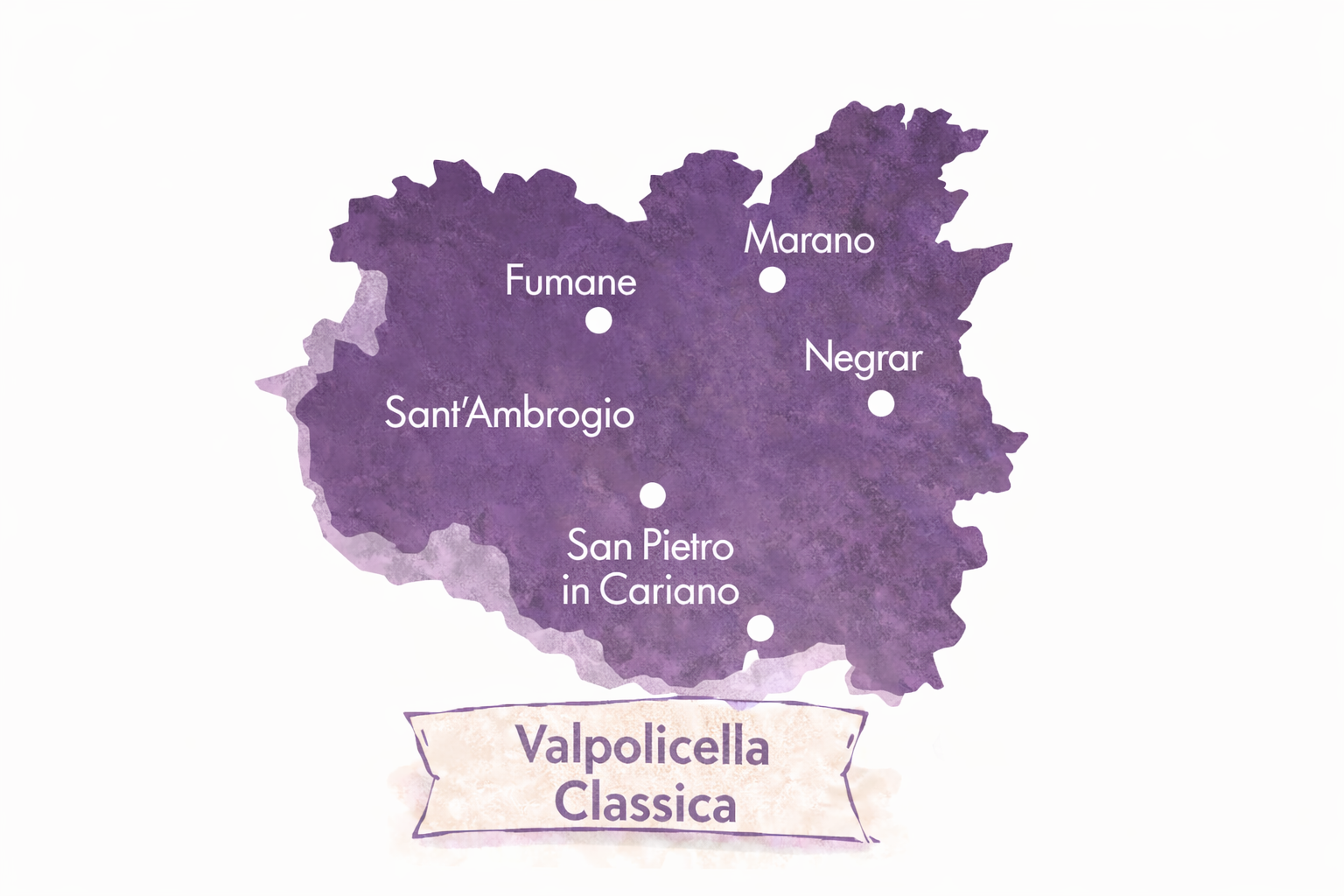 Valpolicella Classica is the historic heart of the region, where Valpolicella’s reputation first formed. The production rules define the Classica area through five key geographical units: the areas of Sant’Ambrogio di Valpolicella and San Pietro in Cariano, plus the valleys of Fumane, Marano di Valpolicella, and Negrar di Valpolicella.
Vineyards here are often planted on hillside terraces with good drainage and varied exposures. Many of the higher sites are influenced by limestone rich soils descending from the Lessini. These conditions often support wines with firm structure, bright acidity, and strong ageing capacity, particularly in Amarone.
Stylistically, many Classica based producers have historically leaned toward balance and longevity, often pairing appassimento with restrained oak influence and long maturation. Producers commonly associated with this part of the region include Giuseppe Quintarelli, Masi, Le Ragose, and Domini Veneti.
A closer look at the Classica valleys and soils
Microclimatic variation inside Classica is exceptional. Soils include alluvial deposits from Lessini streams, ancient volcanic materials in certain pockets, chalk, clay, loam, and frequent limestone rich components. Two famous limestone marl formations are often cited as especially valued: biancone (paler) and scaglia rossa (reddish). The most important point is not romance, but function: these soils can combine drainage, heat retention, and water balance in ways that help grapes ripen evenly.
Sant’Ambrogio: the westernmost area, close to the Adige and Lake Garda, strongly shaped by cool lake breezes. The moderating effect can reduce extremes of heat and cold. Expect wines with controlled power and a firmer line.
San Pietro in Cariano: often flatter overall but with notable hills. It can benefit from lake influence while also being exposed to warmer conditions from the south. Its stony and limestone rich elements support drainage and definition.
Fumane: one of the most dramatic gradients in the region, with elevation that can rise above fog and humidity. Limestone presence can support even ripening and resilience to temperature swings.
Marano: a long valley with many south facing slopes. In places, volcanic basalt rocks (often locally noted) can correlate with firmer acidity, which is valuable in Amarone for freshness.
Negrar: the widest and longest valley, stretching from plains to mountains, with many microclimates due to how the valley narrows. Limestone rich zones can produce wines with finesse, power, and longevity.
Valpantena
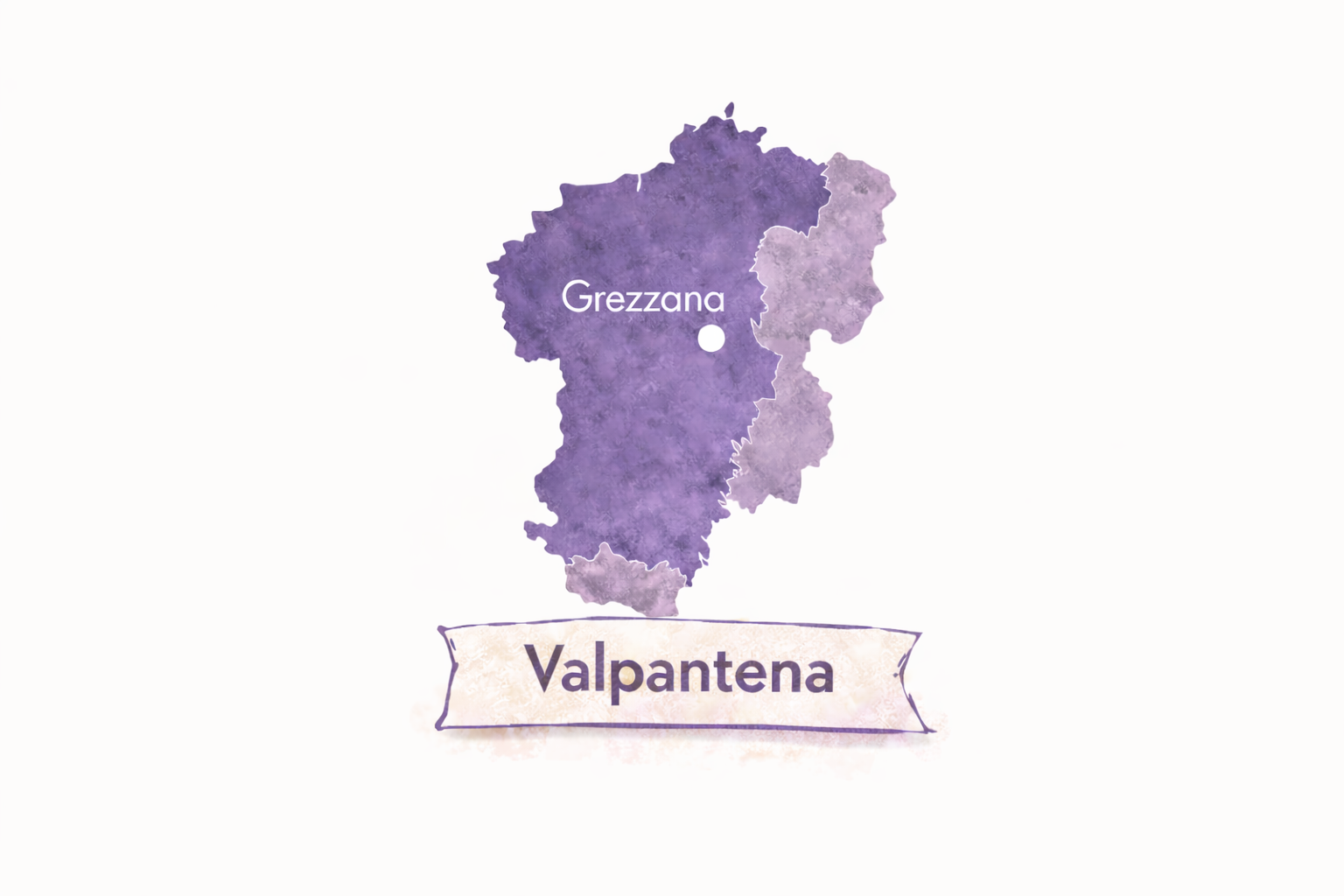 Valpantena is a distinct valley that sits close to Verona and is officially recognized as its own zone. It lies between the Classica area and the eastern valleys, stretching from near Verona toward the higher tops of the Lessini Mountains and narrowing as it rises.
This geography creates variation within the valley itself. Lower sites closer to Verona can achieve generous ripeness, while higher elevations maintain freshness and structure. As a result, Valpantena wines can combine fruit depth with definition and balance.
In tasting terms, Amarone labeled Valpantena often sits in a middle ground, combining clear fruit expression with structural clarity. Producers working with Valpantena fruit include Bertani and other estates with holdings in and around the valley.
Extended Valpolicella DOC
Beyond Classica and Valpantena, the production rules identify a broader Valpolicella DOC area. This includes districts of the municipality of Verona and the valleys of Illasi, Tramigna, and Mezzane, among others. It is the largest and most varied part of the denomination.
Many vineyards here sit at lower or gentler elevations compared with the steepest Classica hills, although important high sites also exist. Warmer growing conditions in certain areas can support a rounder fruit profile and fuller body. In other sectors, especially at altitude, structure and acidity remain pronounced.
This diversity has supported a wide spectrum of Amarone styles, from concentrated and polished interpretations with pronounced oak influence to more restrained and site driven expressions. Producers often associated with the more powerful direction include Romano Dal Forno, Carlo Ferragù, and Corte Canella.
Terroir: a practical definition
“Terroir” is contested, but it remains useful. At its most basic, terroir describes the influence of the local environment on the final wine. That influence includes weather, soil, and topography (aspect, altitude, slope, and airflow). The debate about whether minerals directly translate into flavor will continue, but what is not debated is the importance of drainage, water holding capacity, heat retention, and temperature variation, all of which affect ripeness and balance.
In Valpolicella, terroir matters intensely. The lake, the river, the mountains, the flatlands, and the shifting winds can all change the growing season in small but meaningful ways. This is why microclimates matter, and why the best sites are often those where elevation and airflow help reduce excessive humidity and protect grapes as harvest approaches.
Zoning and vineyard research
Over the past decades, detailed viticultural zoning studies have mapped soils, slopes, and exposures across the denomination. These studies identify homogeneous units and help producers understand the potential of specific vineyard parcels. While not all of this information appears on labels, it influences planting decisions, harvest timing, and blending choices.
As a result, two Amarone wines made from the same grape varieties and following the same appassimento process can differ significantly because they originate from different valleys, altitudes, and soil types.
What this means when choosing an Amarone
All three zones can produce excellent wines, and many producers blend fruit across areas to build balance. Still, understanding the internal geography gives you a practical tool when you read a label or compare producers.
Classica is often associated with tension and long ageing structure. Valpantena often combines ripeness with clarity and freshness. The broader DOC area ranges widely but is frequently linked to richer and more powerful expressions, especially from warmer sites.
Knowing where the grapes come from will not tell you everything, but it can explain a great deal about why one Amarone feels lifted and precise while another feels broader and more concentrated.
The short version
Name: Valpolicella DOC
Sub names: Valpolicella Classico, Valpolicella Valpantena, and the broader Valpolicella DOC area (often informally described as Allargata or Estesa).
More specific names you may see: Valleys and areas such as Avesa, Fumane, Illasi, Marano, Marcellise, Mezzane, Negrar, Quinzano, Squaranto, Tramigna, and Valpantena, plus villages including Sant’Ambrogio and San Pietro in Cariano.
Water influence: cool air and moderation from Lake Garda and the Adige, with broader regional influences that shape airflow and humidity.
Soils: varied, often mixing alluvial deposits, limestone, and pockets of volcanic material. For winegrowing, the key is how these affect drainage and heat retention.
Origin of the name: uncertain, with a first recorded appearance in the 12th century.




 United States
 Canada
 United Kingdom
 Norway
 Switzerland
 Singapore
 South Korea
 Hong Kong
 Japan
Japan Australia
 New Zealand
 Taiwan
 Germany
 Belgium
 Luxembourg
 Netherlands
 France
 Austria
 Denmark
 Portugal
 Spain
Spain Ireland
 Sweden
 Finland
 Rest of the European Union
 Italy
Italy
2 thoughts on “Valpolicella Land: Zones, Valleys, and Terroir”